
How Long Does SEO Take? A Realistic Timeline for 2026
You paid for SEO three months ago. Your rankings barely moved, and your agency keeps saying “be patient.” That silence costs you money and trust. So here is the straight answer: how long does SEO take? Google’s guidance points to four months to a year, and this guide shows what happens in each month, what speeds it up, and how to track progress.
How Long Does SEO Take to Show Results?
Most businesses see measurable SEO results within four to twelve months. Maile Ohye, a former Google Developer Programs Tech Lead, said SEOs typically need four months to a year to implement improvements and see the benefit. That window includes the work itself, not just the waiting.
Early signs arrive in a set order. Impressions and indexed pages grow first, clicks follow, and leads come last. If you only watch leads, the first quarter looks like nothing is happening.
Why SEO Takes Months, Not Weeks
Google has to find your page, render it, index it, and then compare it with pages that already rank. Each step takes time, and you cannot speed up the last one by asking. The pages you compete with often carry years of backlinks and proven engagement.
Search intent adds another layer. Google checks whether your page answers the query better than the current top results, not whether it repeats the keyword. A page about SEO services that reads like a blog post loses to a page built for buyers.
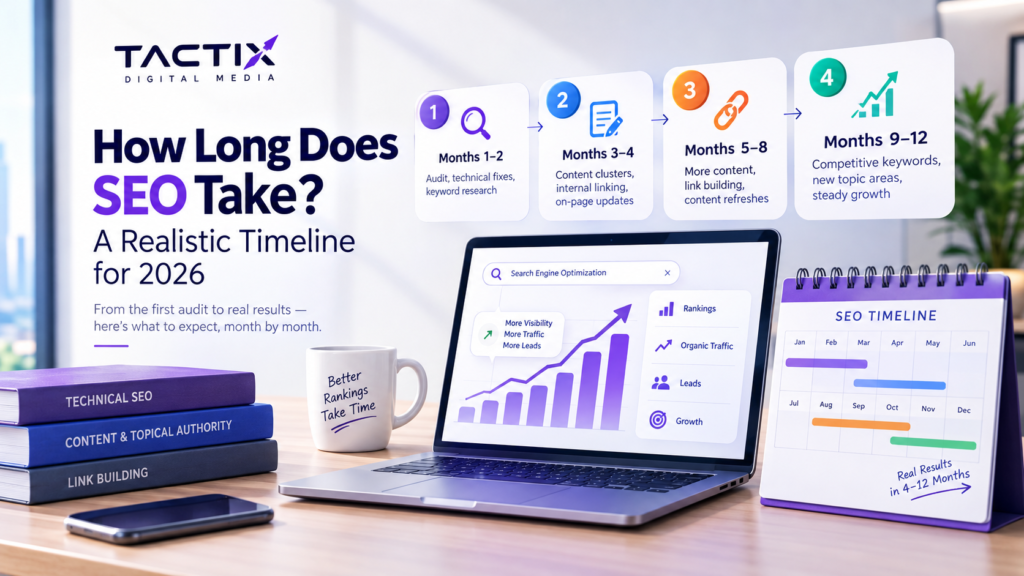
The SEO Timeline, Month by Month
| Months | Focus | What you will see |
|---|---|---|
| 1 to 2 | Audit, technical fixes, keyword and intent research | Cleaner indexing, fewer errors, baseline data |
| 3 to 4 | First topic cluster, internal linking, on-page updates | Impressions rise, long-tail keywords appear on pages 2 to 5 |
| 5 to 8 | More cluster content, link building, content refreshes | Long-tail keywords reach page 1, first organic leads |
| 9 to 12 | Competitive keywords, new topic areas | Steady traffic growth, better lead quality |
Months one and two feel unglamorous. You fix crawl errors, repair slow pages, and tune Core Web Vitals, which measure loading speed, responsiveness, and visual stability. Nothing ranks higher yet, but every later step depends on this base.
SEO Timeline for New Websites vs Established Sites
The SEO timeline for new websites runs longer. A new domain has no history, no backlinks, and no engagement data, so Google has little to trust. Expect the upper end of the four-to-twelve-month range before competitive keywords move.
An established site starts from a stronger position. It already has indexed pages, links, and brand searches. An audit usually finds quick wins there: pages stuck on page two, thin pages to merge, and broken internal links.
What Speeds Up SEO Results
Topical authority. Topical authority means covering a subject so completely that Google treats your site as a reliable source on it. One pillar page supported by cluster posts that answer related questions builds it faster than scattered articles. Our SEO services page works as the pillar, and every SEO article on this site links back to it.
Semantic SEO. Semantic SEO means writing for meaning, not just keywords. Cover the entities and related terms a searcher expects: crawling, indexing, search intent, backlinks, schema, and Search Console. Answer the People Also Ask questions inside the same article.
E-E-A-T. Show real experience with named authors, original examples, and cited sources. Google’s guidance on helpful, reliable, people-first content gives you a checklist to audit your own pages.
Consistent publishing. A cluster needs volume and upkeep. Our content marketing services plan, write, and refresh those posts so the cluster keeps growing.
SEO for AI Overviews: A Parallel Track
SEO for AI Overviews starts from the same foundation as regular SEO. Google’s page on AI features and your website says a page must be indexed and eligible to appear in Search with a snippet to show up in AI features. It does not require special markup.
Your month-one technical work therefore serves AI search too. Use clear headings, put a direct answer near the top of each section, and cite your facts so your pages are easy to quote. Track AI visibility next to rankings in Search Console, where Google reports clicks from AI features inside the Web search totals.
How Long SEO Takes in Different Markets
Competition sets the pace. A Lahore service business targeting a local keyword usually moves faster than a US company chasing a national head term. In the UAE, bilingual Arabic and English content adds work, and it reaches searchers that English-only competitors miss. Our page on digital marketing agency in Dubai explains how we run UAE campaigns.
In the UK and USA, local rankings depend on Google Business Profile quality and reviews as much as on page content. Plan for both from month one.
How to Track Progress Before Leads Arrive
Watch these signals in order:
- Indexed pages: confirms Google can see your work.
- Impressions and average position: shows you are entering results.
- Number of ranking keywords: shows topical authority growing.
- Organic clicks: shows your titles and snippets earn attention.
- Leads: form fills, calls, and WhatsApp chats from organic visits.
While SEO builds, Google Ads management can bring traffic from week one. Use ads to learn which keywords convert, then feed those into your SEO plan. To turn that traffic into enquiries, read our guide on content marketing for lead generation.
Red Flags in SEO Timelines
Nobody can guarantee a number one ranking. Google says so in its guidance on hiring an SEO professional. Walk away from any agency that promises page-one results in 30 days, sells link packages with no content plan, or refuses to share monthly reports.
FAQs
Can SEO work in 30 days?
You can see technical fixes indexed and impressions rising within 30 days. Meaningful traffic and leads usually take longer, in line with the four-to-twelve-month range.
Is SEO faster than Google Ads?
No. Ads send traffic as soon as a campaign goes live. SEO builds slowly and keeps paying after you stop spending.
How long does a new website take to rank?
Plan for the upper end of the range, close to 12 months for competitive keywords. Long-tail keywords often move earlier.
Get a Timeline Built for Your Site
Every site starts from a different point, so your timeline depends on your domain history, competitors, and market. Review our pricing plans, browse our portfolio, or contact our team for an SEO audit and a realistic plan.